"Ebola" redirects here. For other uses,
see Ebola (disambiguation).
|
Ebola virus disease
 |
|
|
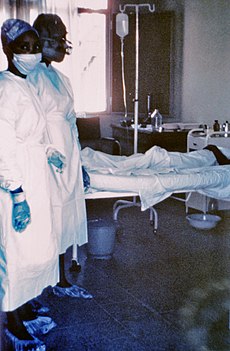
Two nurses standing near Mayinga
N'Seka, a nurse with Ebola virus disease in the 1976
outbreak in Zaire. N'Seka died a few days later.
|
|
|
Classification and external resources
|
|
Ebola virus disease (EVD; also Ebola
hemorrhagic fever, or EHF), or simply Ebola, is
a viral hemorrhagic fever of humans and
other primates caused
by ebolaviruses.
Signs and symptoms typically start between two days and three weeks after
contracting the virus with a fever, sore throat, muscular pain,
and headaches.
Then, vomiting, diarrhea and rash usually
follow, along with decreased function of the liver and kidneys. At this
time some people begin to bleed both internally and
externally.[1] The
disease has a high risk of death, killing between 25 and 90 percent of those
infected, with an average of about 50 percent.[1] This
is often due to low blood pressure from fluid loss, and typically
follows six to sixteen days after symptoms appear.[2]
The virus spreads by direct contact with body fluids,
such as blood,
of an infected human or other animals.[1] This
may also occur through contact with an item recently contaminated with bodily
fluids.[1] Spread
of the disease through the air between primates, including humans, has not been
documented in either laboratory or natural conditions.[3] Semen or breast
milk of a person after recovery from EVD may carry the virus for
several weeks to months.[1][4][5] Fruit bats are
believed to be the normal carrier in nature, able to spread the virus
without being affected by it. Other diseases such as malaria, cholera, typhoid
fever, meningitis and other viral hemorrhagic fevers may
resemble EVD. Blood samples are tested for viral RNA, viral antibodies or
for the virus itself to confirm the diagnosis.[1]
Control of outbreaks requires coordinated medical services,
alongside a certain level of community engagement. The medical services include
rapid detection of cases of disease, contact
tracingof those who have come into contact with infected individuals, quick
access to laboratory services, proper healthcare for those who are infected,
and proper disposal of the dead throughcremation or
burial.[1][6] Samples
of body fluids and tissues from people with the disease should be handled with
special caution. Prevention includes limiting the spread of disease from
infected animals to humans. This may be done by handling potentially
infected bush meat only while wearing protective clothing and
by thoroughly cooking it before eating it. It also includes wearing proper
protective clothing and washing
hands when around a person with the disease.[1] No
specific treatment or vaccine for the virus is available, although a number of
potential treatments are being studied. Supportive efforts, however, improve
outcomes. This includes either oral rehydration therapy (drinking
slightly sweetened and salty water) or giving intravenous fluids as well as treating
symptoms.[1]
The disease was first identified in 1976 in two simultaneous
outbreaks, one in Nzara, and the other in Yambuku, a
village near the Ebola River from which the disease takes its name.[7] EVD outbreaks occur intermittently in
tropical regions of sub-Saharan Africa.[1] Between
1976 and 2013, the World Health Organization reports a
total of 24 outbreaks involving 1,716 cases.[1][8] The
largest outbreak is the ongoing epidemic in West Africa, still
affecting Guinea and Sierra
Leone.[9][10][11] As
of 13 October 2015, this outbreak has 28,502 reported cases resulting in 11,312
deaths.[12]
Contents
[hide]
- 1 Signs
and symptoms
- 2 Cause
- 3 Pathophysiology
- 4 Diagnosis
- 5 Prevention
- 6 Management
- 7 Prognosis
- 8 Epidemiology
- 9 Society
and culture
- 10 Other
animals
- 11 Research
- 12 See
also
- 13 References
- 14 External
links
Signs and symptoms

Onset
The length of time between exposure to the virus and the
development of symptoms (incubation
period) is between 2 to 21 days,[1][13] and
usually between 4 to 10 days.[14] However,
recent estimates based on mathematical models predict that around 5% of cases
may take greater than 21 days to develop.[15]
Symptoms usually begin with a sudden influenza-like
stage characterized by feeling
tired, fever, weakness, decreased appetite, muscular pain, joint pain,
headache, and sore throat.[1][14][16][17] The
fever is usually higher than 38.3 °C (101 °F).[18] This
is often followed by vomiting, diarrhea and
abdominal pain.[17] Next, shortness of breath and chest pain may
occur, along with swelling, headachesand confusion.[17] In
about half of the cases, the skin may develop a 斑丘疹的皮疹maculopapular rash, a flat red area covered with small bumps, 5 to 7 days after
symptoms begin.[14][18]
Bleeding
In some cases, internal and external bleeding may occur.[1] This
typically begins
five to seven days after the first symptoms.[19] All
infected people show some decreased
blood clotting.[18] Bleeding
from mucous membranes or from sites of needle punctures has been reported in
40–50 percent of cases.[20] This
may cause vomiting blood, coughing up of
blood, or blood in stool.[21] Bleeding
into the skin may create petechiae, purpura, ecchymoses or hematomas (especially
around needle injection sites).[22] Bleeding into the whites of the eyes may
also occur. Heavy bleeding is uncommon; if it occurs, it is usually located within the gastrointestinal tract.[18][23]
Recovery and death
Recovery may begin between 7 and 14 days after first
symptoms.[17] Death,
if it occurs, follows typically 6 to 16 days from first symptoms and is often
due to low blood pressure from fluid loss.[2] In general,
bleeding often indicates a worse outcome, and blood loss may result in death.[16] People
are often in a coma near
the end of life.[17]
Those who survive often have ongoing muscular and joint
pain, liver
inflammation, decreased hearing, and may have continued feelings of
tiredness, continued weakness, decreased appetite, and difficulty returning to pre-illness
weight.[17][24] Problems
with vision may develop.[25]
Additionally they develop antibodies against
Ebola that last at least 10 years, but it is unclear if they are immune to
repeated infections.[26]
Cause
EVD in humans is caused by four of five viruses of the
genus Ebolavirus. The four are Bundibugyo
virus (BDBV), Sudan virus (SUDV), Taï Forest virus (TAFV) and one simply
called Ebola virus (EBOV, formerly Zaire Ebola virus).[27] EBOV,
species Zaire ebolavirus, is the most dangerous of
the known EVD-causing viruses, and is responsible for the largest number of
outbreaks.[28] The
fifth virus, Reston virus (RESTV), is not thought to cause
disease in humans, but has caused disease in other primates.[29][30] All
five viruses are closely related to marburgviruses.[27]
Virology
Ebolaviruses contain single-stranded, non-infectious RNA genomes.[31] Ebolavirus genomes
contain seven genes including 3'-UTR-NP-VP35-VP40-GP-VP30-VP24-L-5'-UTR.[22][32] The
genomes of the five different ebolaviruses (BDBV, EBOV, RESTV, SUDV and TAFV)
differ in sequence and the number and location of
gene overlaps. As with all filoviruses,
ebolavirus virions are filamentous
particles that may appear in the shape of a shepherd's crook, of a "U" or of a
"6," and they may be coiled, toroid or branched.[32][33] In
general, ebolavirions are 80 nanometers (nm) in width and may be as long as
14,000 nm.[34]
Their life cycle is thought to begin with a
virion attaching to specific cell-surface receptors such as C-type
lectins, DC-SIGN, or integrins,
which is followed by fusion
of the viral envelope with cellular membranes.[35] The
virions taken up by the cell then travel to acidic endosomes and lysosomes where
the viral envelope
glycoprotein GP is cleaved.[35] This
processing appears to allow the virus to bind to cellular proteins enabling it
to fuse with internal cellular membranes and release the viral nucleocapsid.[35] The Ebolavirus structural
glycoprotein (known as GP1,2) is responsible for the virus' ability to bind to
and infect targeted cells.[36] The
viral RNA polymerase, encoded by the L gene,
partially uncoats the nucleocapsid
and transcribes the genes into positive-strand mRNAs, which are
then translated into structural and
nonstructural proteins. The most abundant protein produced is the nucleoprotein, whose
concentration in the host主人 cell determines when L switches from gene transcription抄写 to genome基因组
replication. Replication of the viral genome results in full-length,
positive-strand antigenomes that are, in turn, transcribed into genome copies
of negative-strand virus progeny后裔.[37] Newly
synthesized 合成的structural
proteins and genomes self-assemble. 自组装 and accumulate near the inside of the cell
membrane. Virions bud off发芽
from the cell, gaining their envelopes from the cellular membrane from which
they bud from. The mature progeny particles then infect 感染other cells to repeat the cycle. The genetics of the
Ebola virus are difficult to study because of EBOV's virulent characteristics.[38]
Transmission
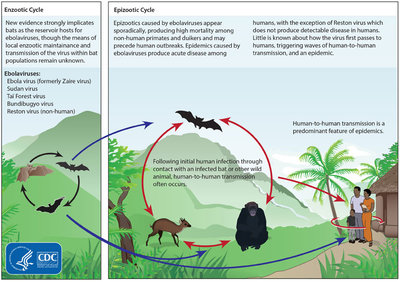
Life cycles of the Ebolavirus
It is believed that between people, Ebola disease spreads
only by direct contact with the blood or body fluids of
a person who has developed symptoms of the disease.[39][40][41] Body
fluids that may contain Ebola viruses include saliva, mucus, vomit, feces,
sweat, tears, breast milk, urine and semen.[26][4] The
WHO states that only people who are very sick are able to spread Ebola disease
in saliva,
and whole virus has not been reported to be transmitted through sweat. Most
people spread the virus through blood, feces and
vomit.[42] Entry
points for the virus include the nose, mouth, eyes, open wounds, cuts and
abrasions皮肤] 擦伤.[26] Ebola
may be spread through largedroplets; however, this is believed to occur only when a
person is very sick.[43] This
contamination can happen if a person is splashed with droplets.[43] Contact
with surfaces or objects contaminated by the virus, particularly needles and
syringes, may also transmit the infection.[44][45] The
virus is able to survive on objects for a few hours in a dried state, and can
survive for a few days within body fluids outside of a person.[26][46]
The Ebola virus may be able to persist for more than 3
months in the semen after recovery, which could lead to infections via sexual intercourse.[4][47][48] Ebola
may also occur in the breast milk of women after recovery, and it is not known
when it is safe to breastfeed again.[5] The
virus was also found in the eye of one patient in 2014, two months after it was
cleared from his blood.[49] Otherwise,
people who have recovered are not infectious.[44]
The potential for widespread
infections in countries with medical systems capable of observing
correct medical isolation procedures is considered low.[50] Usually
when someone has symptoms of the disease, they are unable to travel without
assistance.[51]
Dead bodies remain infectious; thus, people handling human
remains in practices such as traditional burial rituals or more modern
processes such as embalming are
at risk.[50] 69%
of the cases of Ebola infections in Guinea during the 2014 outbreak are
believed to have been contracted via unprotected (or unsuitably protected)
contact with infected corpses尸体
during certain Guinean burial rituals.[52][53]
Health-care workers treating people with Ebola are at
greatest risk of infection.[44] The
risk increases when they do not have appropriate protective clothing such as masks,
gowns, gloves and eye protection; do not wear it properly; or handle
contaminated clothing incorrectly.[44] This
risk is particularly common in parts of Africa where the disease mostly occurs
and health systems function poorly.[54] There
has been transmission in hospitals in some African countries that reuse
hypodermic needles.[55][56] Some
health-care centers caring for people with the disease do not have running
water.[57] In
the United States the spread to two medical workers treating infected patients
prompted criticism of inadequate training and procedures.[58]
Human-to-human
transmission of EBOV through the air has not been reported to occur during EVD
outbreaks,[3] and
airborne空气传播的 transmission has only been demonstrated 已证明的in very strict 严格的laboratory conditions, and then only from pigs toprimates, but
not from primates灵长类 to primates.[39][45] Spread
of EBOV by water, or food other than bushmeat丛林肉
, has not been observed.[44][45] No
spread by mosquitos or other insects has been reported.[44] Other
possible methods of transmission are being studied.[46]
The apparent lack of airborne transmission among humans is
believed to be due to low levels of the virus in the lungs and other
parts of the respiratory system of primates,
insufficient to cause new infections.[59] A
number of studies examining airborne transmission broadly concluded that
transmission from pigs to primates could happen without direct contact because,
unlike humans and primates, pigs with EVD get very high ebolavirus
concentrations in their lungs, and not their bloodstream.[60] Therefore,
pigs with EVD can spread the disease through droplets in the air or on the
ground when they sneeze or cough.[61] By
contrast, humans and other primates accumulate the virus throughout their body
and specifically in their blood, but not very much in their lungs.[61] It
is believed that this is the reason researchers have observed pig to primate
transmission without physical contact, but no evidence has been found of
primates being infected without actual contact, even in experiments where
infected and uninfected primates shared the same air.[60][61]
Initial case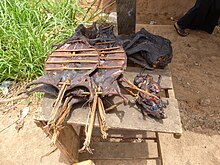
Bushmeat being prepared for cooking in Ghana. In Africa,
wild animals including fruit bats are hunted for food and are referred to as
bushmeat.[62][63] In
equatorial Africa, human consumption of bushmeat has been linked to
animal-to-human transmission of diseases, including Ebola.[64]
Although it is not entirely clear how Ebola initially
spreads from animals to humans, the spread is believed to involve direct
contact with an infected wild animal or fruit bat.[44] Besides
bats, other wild animals sometimes infected with EBOV include several monkey
species, chimpanzees黑猩猩, gorillas,
baboons 狒狒and duikers小羚羊.[65]
Animals may become infected when they eat fruit partially
eaten by bats carrying the virus.[66] Fruit
production, animal behavior and other factors may trigger outbreaks among
animal populations.[66]
Evidence indicates that both domestic dogs and pigs can also
be infected with EBOV.[67] Dogs
do not appear to develop symptoms when they carry the virus, and pigs appear to
be able to transmit the virus to at least some primates.[67] Although
some dogs in an area in which a human outbreak occurred had antibodies to EBOV,
it is unclear whether they played a role in spreading the disease to people.[67]
Reservoir
The natural
reservoir for Ebola has yet to be confirmed; however, bats are considered
to be the most likely candidate species.[45] Three
types of fruit bats (Hypsignathus monstrosus, Epomops
franqueti and Myonycteris torquata) were found to
possibly carry the virus without getting sick.[68] As
of 2013, whether other animals
are involved in its spread is not known.[67] Plants, arthropods and birds have also
been considered possible viral reservoirs.[1]
Bats were known
to roost;群栖的禽鸟 in the cotton factory in which the first cases of
the 1976 and 1979 outbreaks were observed, and they have also been implicated有牵连的 in Marburg virus infections in 1975 and 1980.[69] Of
24 plant and 19 vertebrate species experimentally inoculated给…做注射预防针 with EBOV, only bats
became infected.[70] The
bats displayed no clinical signs of disease, which is considered evidence that
these bats are a reservoir species of EBOV. In a 2002–2003 survey of
1,030 animals including 679 bats from Gabon and
the Republic of the Congo, 13 fruit bats
were found to contain EBOV RNA.[71]Antibodies
against Zaire and Reston viruses have been found in fruit bats in Bangladesh,
suggesting that these bats are also可能性 potential
hosts [生物] 寄主
of the virus and that the filoviruses are present in Asia.[72]
Between 1976 and 1998, in 30,000 mammals, birds,
reptiles, amphibians and arthropods sampled from regions of EBOV outbreaks, no
Ebola virus was detected apart from some genetic traces found in six rodents
(belonging to the speciesMus setulosus and Praomys) and
one shrew (Sylvisorex
ollula) collected from the Central African Republic.[69][73] However,
further research efforts have not confirmed rodents as a reservoir.[74] Traces
of EBOV were detected in the carcasses of gorillas and chimpanzees during
outbreaks in 2001 and 2003, which later became the source of human infections.
However, the high rates of death in these species resulting from EBOV infection
make it unlikely that these species represent a natural reservoir for the
virus.[69]
Pathophysiology
Pathogenesis schematic
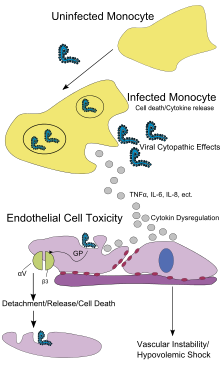
Similar to other filoviruses, EBOV replicates very
efficiently in many cells,
producing large amounts of virus in monocytes, macrophages, dendritic
cells and other cells including liver cells, fibroblasts,
and adrenal gland cells.[75] Viral
replication triggers the release
of high levels of inflammatory chemical signals and leads to a septic state.[24]
EBOV is thought to infect humans through contact with mucous
membranes or through skin breaks.[39] Once
infected, endothelial cells (cells lining the inside
of blood vessels), liver cells, and several types of immune cells such as macrophages, monocytes, and dendritic
cells are the main targets of infection.[39] Following
infection with the virus, the immune cells carry the virus to nearby lymph nodes where
further reproduction of the virus takes place.[39] From
there, the virus can enter the bloodstream and lymphatic
system and spread throughout the body.[39] Macrophages
are the first cells infected with the virus, and this infection results
in programmed
cell death.[34] Other
types of white blood cells, such as lymphocytes,
also undergo programmed cell death leading to an abnormally low
concentration of lymphocytes in the blood.[39] This
contributes to the weakened immune response seen in those infected with EBOV.[39]
Endothelial cells may be infected within 3 days after
exposure to the virus.[34] The
breakdown of endothelial cells leading to blood
vessel injury can be attributed to EBOV glycoproteins.
This damage occurs due to the synthesis of Ebola virus glycoprotein (GP), which
reduces the availability of specific integrins responsible
for cell adhesion to the intercellular structure and causes liver damage,
leading to improper clotting. The widespread bleeding that
occurs in affected people causes swelling and shock
due to loss of blood volume.[76] The dysfunction in bleeding and
clotting commonly seen in EVD has been attributed to increased
activation of the extrinsic pathway of the coagulation cascade due to
excessive tissue factor production by macrophages and
monocytes.[14]
After infection, a secreted glycoprotein,
small soluble glycoprotein (sGP or GP) is synthesized. EBOV replication
overwhelms protein synthesis of infected cells and the host immune defenses.
The GP forms a trimeric complex, which tethers the virus to
the endothelial cells. The sGP forms a dimeric
protein that interferes with the signaling of neutrophils,
another type of white blood cell, which enables the virus to evade the immune
system by inhibiting early steps of neutrophil activation. The presence of
viral particles and the cell damage resulting from viruses budding out of the
cell causes the release of chemical signals (such
as TNF-α, IL-6 and IL-8),
which are molecular signals for fever and inflammation.
Immune system evasion
Filoviral infection also interferes with proper functioning
of the innate immune system.[35][37] EBOV
proteins blunt the human immune system's response to viral infections by
interfering with the cells' ability to produce and respond to interferon
proteins such as interferon-alpha, interferon-beta,
and interferon gamma.[36][77]
The VP24 and VP35 structural proteins of EBOV play a key
role in this interference. When a cell is infected with EBOV, receptors located
in the cell's cytosol (such as RIG-I and MDA5) or outside of
the cytosol (such as Toll-like receptor 3 (TLR3), TLR7, TLR8 and TLR9), recognize infectious molecules associated
with the virus.[36] On
TLR activation, proteins including interferon regulatory factor 3 and interferon regulatory factor 7 trigger
a signaling cascade that leads to the expression of type
1 interferons.[36] The
type 1 interferons are then released and bind to the IFNAR1 and IFNAR2 receptors
expressed on the surface of a neighboring cell.[36] Once
interferon has bound to its receptors on the neighboring cell, the signaling
proteins STAT1 and STAT2 are
activated and move to the cell's
nucleus.[36] This
triggers the expression of interferon-stimulated
genes, which code for proteins with antiviral properties.[36] EBOV's
V24 protein blocks the production of these antiviral proteins by preventing the
STAT1 signaling protein in the neighboring cell from entering the nucleus.[36] The
VP35 protein directly inhibits the production of interferon-beta.[77] By
inhibiting these immune responses, EBOV may quickly spread throughout the body.[34]


No comments:
Post a Comment